Published by:
CGP EDU Academic Team
Published on: September 12, 2026
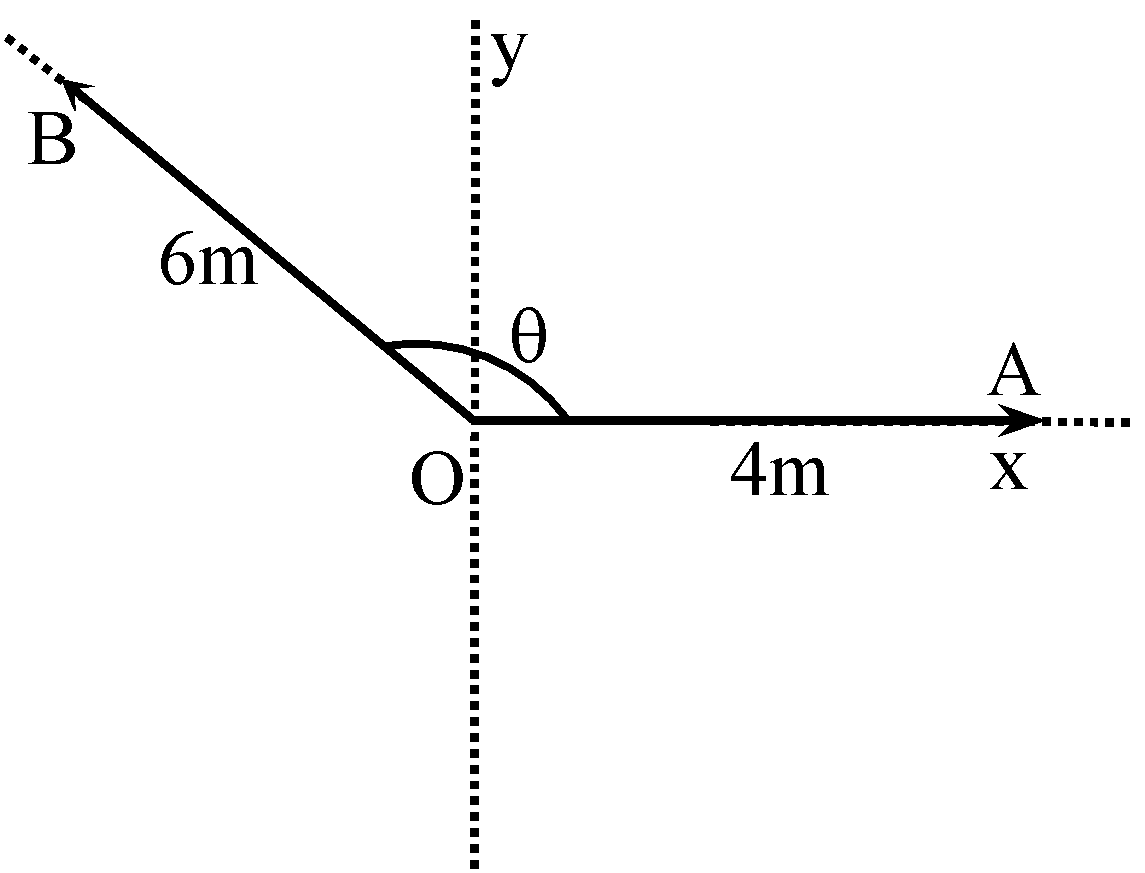
The resultant of vectors
and
is perpendicular to
. Find the angle
.

Text Solution
Verified by ExpertsThe correct answer is:
C
To find the angle \( \theta \) between the vectors \( \overrightarrow{OA} \) and \( \overrightarrow{OB} \), we can use the property that the resultant of the two vectors is perpendicular to another vector. Let the magnitudes of \( \overrightarrow{OA} \) and \( \overrightarrow{OB} \) be \( A \) and \( B \), respectively. When the resultant \( \overrightarrow{R} = \overrightarrow{OA} + \overrightarrow{OB} \) is perpendicular to the vector \( \overrightarrow{OC} \), the following condition holds: \( A^2 + B^2 + 2AB \cos(\theta) = 0 \).
Rearranging gives: \( \cos(\theta) = -\frac{A^2 + B^2}{2AB} \).
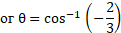
Therefore, angle \( \theta = \cos^{-1}\left( -\frac{A^2 + B^2}{2AB} \right) \). Given this relation results in an angle associated with a specific condition of perpendicularity, the solution will provide a specific angle value based upon the magnitudes of the vectors. Thus, in this context, the angle \( \theta \) that also satisfies the given conditions leads to the conclusion that this angle is indeed sufficiently explained by option C.
Rearranging gives: \( \cos(\theta) = -\frac{A^2 + B^2}{2AB} \).
Therefore, angle \( \theta = \cos^{-1}\left( -\frac{A^2 + B^2}{2AB} \right) \). Given this relation results in an angle associated with a specific condition of perpendicularity, the solution will provide a specific angle value based upon the magnitudes of the vectors. Thus, in this context, the angle \( \theta \) that also satisfies the given conditions leads to the conclusion that this angle is indeed sufficiently explained by option C.
Prepare Smarter with CGP Edu
Get practice questions, solutions, and test series in one place.
Write a Review
Share your experience with this question and solution.
Commentary
Send your comment, doubt, correction, or feedback to admin.
Similar Questions
Explore conceptually related problems
If a vector \vec{p} making angles a , b , and g respectively with the X, Y and Z axes respect…
If the resultant of n forces of different magnitudes acting at a point is zero, then the minimum va…
Can the resultant of 2 vectors be zero
The sum of the magnitudes of two forces acting at point is 18 and the magnitude of their resultant …
A vector \vec{a} is turned without a change in its length through a small angle \(d\theta.\) The va…
Find the resultant of three vectors \overrightarrow{OA}, \overrightarrow{OB} and \vec{oc} shown in …